Monday, January 28, 2013

Costa Rica's Vultures.... so prevalent they could be the National Bird!

Travel anywhere in Costa Rica and you're bound to see several species of Vultures soaring high overhead. Known in Spanish as "Zopilotes", whether it is the Black Vulture (Coragyps atratus), the Turkey Vulture (Carthartes aura), or the surprisingly majestic King Vulture (Sarcoramphus papa), there is no way you can spend a day in Costa Rica without spotting large flocks of these ghastly yet at times elegant birds.

Black Vulture
Field marks: Large, heavy-bodied, carrion-eating, black bird, with short tail and broad plank-like wings tipped with white. Wingspan: 5' Length: 2'-2'4" W-L ratio: 2.3:1 Weight: 4.5-6 lbs

Turkey Vulture
Field marks: Large, dark brown, heavy-bodied and small-headed, carrion-eating bird, with a longish tail and two-toned underwings. Wings held above the horizontal in a strong “V.” Wingspan: 5'6" Length: 2'2"-2'8" W-L ratio: 2.4:1 Weight: 3.5-5 lbs


Black and Turkey Vulture Factoids:
• Black & Turkey Vultures belong to the family Cathartidae, a group of 7 species of New World Vultures.
• Black Vultures, rarely flap in flight using broad plank-like wings that allow them to soar in small wind thermals.
• Black Vultures search for carrion exclusively by sight, often following Turkey Vulture’s to take advantage of these bird's acute sense of smell to find food.
• Black & Turkey Vultures sometimes take live prey.
• Black & Turkey Vultures usually roost together in family units.
• Black Vultures nest on the ground and on the floors of abandoned buildings.
• The range of Black Vultures has been expanding northwards since the 1950s.
• Most scientists now believe Turkey vultures and Black vultures are more closely related to storks than to other raptors.
• Turkey Vultures get their name from their red, featherless heads resembling Wild Turkeys (Meleagris gallopavo).
• Turkey Vultures may be more closely related to storks than other raptors.
• Turkey Vultures are the most migratory of all of the New World Vultures.
• The Turkey Vulture’s plumage is dark brown, not black.
• When flying, Turkey Vultures, hold their wings in a “V” above their backs, creating a slight dihedral that stabilizes their flight.
• Turkey Vultures often roost in groups of several hundred birds.
• Turkey Vultures communicate vocally in hisses and grunts.
• Nestling Turkey Vultures projectile vomit to defend themselves.
• Turkey Vultures have weak feet, and are unable to carry off their carrion.

This is so exciting, please tell me more Vulture Facts!
Along with the Turkey Vulture, the Black Vulture is one of the most abundant New World vultures. Prevalent in North America, vultures also breed throughout Central
America and much of South America. Black Vultures are typically found in open or partly forested habitats, often in close proximity to human activity. Traditional communal roost sites can consist of 100's of birds, some of these sites are used for decades at a time, often occupied year-round, especially in areas of temperate climates such as Costa Rica. Roosts are thought to play an important role in the social lives of vultures as a place for juveniles and adults to interact and as a staging area for foraging groups to assemble. Turkey Vultures and Crested Caracaras often roost together with Black Vultures.

Identification
Black Vultures have featherless dark gray to black heads and necks and are ugly as hell. They appear completely black when perched, however obvious white patches near
the wingtips are clearly visible when in flight and you will see these hideous birds everywhere. The gray legs and toes often are stained whitish with excrement, oh my.....isn't that nice. Adult Black Vultures have dark bills with bone-colored tips and their heads and the upper half of their necks are dark gray and covered with wrinkles (hey, wait! I think I'm starting to look like a vulture myself!). Unlike Turkey Vultures, an easy distinction between the two species is Black Vultures hold their wings flat when soaring, rock less, and flap more frequently. The Turkey Vulture are masters at soaring above the canopy, rarely flapping their wings and holding them in a “V” shape, while rocking side-to-side, skillfully using the shifting wind thermals to do the work for them.

Breeding Habits
Unlike the Black Vultures, Turkey Vultures prefer open and forested habitats, typically avoiding urban and suburban areas. In the Americas, both species breed in farmlands, rangelands, forests, and low-elevation mountains. Generally, it only eats the skin and harder parts of the tissue of its meal. Vultures are monogamous and pairs
are believed to mate for life, now isn't that romantic? In fact, family members associate more closely with each other than with other individuals over their lifetime. I guess carrion is like comfort food and brings families together! Vultures do not build a nest, instead laying their eggs in rocky crevices, caves, tree cavities, hollow logs, and such. Vultures though gawky on the ground, perform
incredible aerial displays during courtship, with males circling the females with their necks extended, exhaling loudly and making chasing and diving maneuvers. A successful courtship eventually results in two eggs, which are then incubated for 32-45 days. This romantic couple works together incubating the young, with both parents also sharing the feeding of regurgitated food to their young as often as 20 times a day. Gosh, this romance just keeps getting better! The happy little family generally remains in close contact until the next breeding season, at which time the parents chase their offspring away from the nest site.....their done, time to move on. After leaving their parents, juveniles enter a wandering stage while learning how to search for carcasses on their own. I wonder what the learning curve on that one is?

Feeding Habits
Black Vultures are dirty little opportunistic aerial scavengers. Feeding on carrion of all types and sizes, unlike the Turkey Vultures, this species does not have a keen sense of smell and relies entirely on visuals to locate food. Black Vultures
typically fly at higher altitudes than Turkey Vultures and monitor the behavior of predators and other scavengers in order to find their food. They frequently follow successful Turkey Vultures to carcasses, then aggressively chase them away and taking it as their own. Large numbers of Black Vultures quickly
gather at food sources preferring fresh carcasses, but consuming decaying meat as well. Occasionally Black Vultures capture live prey, most of which are young, weak, or small sickly mammals or birds. Black Vultures also scavenge through trash, feed on vegetable matter including sweet potatoes, pumpkins, coconuts, and in Costa Rica, the fruit of oil palms. Because Turkey Vultures find food using their sense of smell as well as by sight, they are able to locate carcasses on the forest floor beneath dense forest canopies and are better able to rely on fresh food, but will resort to decaying meat when necessary. Generally, the King Vulture actually prefers to eat the skin and harder parts of the tissue for its meal.

Less Common Vultures of Costa Rica
The King Vulture (Sarcoramphus papa) is a colorful large bird found in Central and South America. This vulture lives predominantly in tropical lowland forests stretching
from southern Mexico to northern Argentina, and does not frequent the coastal zones as much as the other vulture species. Large with a predominantly white body, the King Vulture has gray to black ruff, flight, and tail feathers. The head and neck are bald, with the skin color varying, including vivid colors of yellow, orange, blue, purple and red. The King Vulture has a very noticeable yellow fleshy caruncle on its beak. This vulture is a hearty scavenger with an exceptionally strong beak and it often is the one to make the initial cut into a fresh carcass. King Vultures have been known to live for up to 30 years in captivity, I'm hoping at a zoo and not as someone's ghastly avian pet!

Ecology and behavior
The King Vulture can soar effortlessly for hours, only flapping its wings on occasion. While in flight, they hold their wings flat only slightly raising the tips, holding their small heads low, they often appear headless while in flight. These vultures have also been observed engaging in tandem flight which is thought to be a
part of their courtship behavior. Only one or two birds generally descend to feed at a carcass, although up to ten or so may gather if there is a significant amount of food. One of the truly most disgusting features of this species of vulture, is it's said to use urohidrosis, (defecating on its legs) to lower its body temperature. How pleasant, glad to know that. The King Vulture actually lacks a voice box, (wish my husband did sometimes), although it can make low croaking noises and wheezing sounds while in courtship and bill-snapping noises when threatened. The only natural predators for the King Vulture are snakes, which will prey upon the vulture's eggs and young or large cats such as jaguars, which may surprise and kill an adult vulture while feeding at a carcass. Predators? Defecating on the legs? Gross, I'm not hanging out with these guys!

Breeding
The reproductive behavior of the King Vulture in the wild is poorly known. From
mostly captivity they have learned that King Vultures mate for life and generally lay a single unmarked white egg in a nest in the hollow of a tree. To ward against potential predators, the vultures keep their nests foul-smelling. The parents share incubating and brooding duties until the chick is about a week old, with the chicks later taking their first flights at about three months of age.
Because of its large size and beauty, the King Vulture is an attraction at zoos around the world and is a popular photo opportunity when spotted around Costa Rica.

So there you have it! Most everything you ever wanted or didn't want to know about Vultures! Those majestic birds you've been watching fly around your Costa Rica Hotel or Costa Rica Vacation Rental Home each day, may actually have been disgusting flesh eating Vultures! Ew, that's gross! If truth be told though, these birds can actually be quite friendly and comical acting. Some have no fear to waddle right up to your feet if you leave them some fresh food. Besides, there is no arguing that these beasts serve their purpose in the food chain and natural ecology by providing a natural cleaning up of disgusting road kill. So people!! Let's embrace this important species and thank Mother Nature for the vultures!
Okay, so maybe we aren't quite ready to make them the National Bird yet, but have you ever seen Costa Rica's National Bird? Beyond it's beautiful song, it's not particularly impressive! Pura vida!!

Author:
Kimberly Barron, originally from Malibu, California has lived in Parismina and Manuel Antonio, Costa Rica for 20 years. Starting as a certified tour guide, she spent 15 years managing fishing lodges on the Caribbean Coast and later 4* & 5* Hotels on the Pacific Coast of Costa Rica. Currently semi-retired, Kimberly still works as the Marketing Director for Byblos Resort & Casino and Hotel Makanda by the Sea.

Sources:
www.hawkmountain.org/
www.en.wikipedia.org/wiki/Black_Vulture
www.en.wikipedia.org/wiki/King_Vulture

Sunday, January 13, 2013

Calling all Cookie Monsters…Costa Rica’s most Famous Cookie Company!

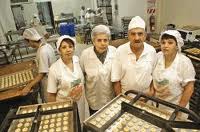
If you’ve ever traveled in Costa Rica, you likely are familiar with Pozuelo products. Perhaps you didn’t even realize it, but if you’ve eaten cookies, crackers, small cakes or other dessert treats off store shelves, then you have surely been eating products of the famous Pozuelo Group! Easily one of the most respected brands in Costa Rica, Riviana Pozuelo has been an integral part of “snacking” in Costa Rica for an amazing 95 years!!

History of the Cookie:
One of the first widely known “foods” worldwide are commonly known as “cookies”. Starting as a kind of long lived flat bread, this food item was most often distributed to crews of ships, as well as groups of soldiers whether out on the high seas or fighting on the battlefield. These days, the term “cookie” can refer to a wide range of food products consisting of a wide variety of shapes and flavors, and most often produced in private homes, bakeries or in larger industrial factory operations. The technical definition of “cookies” (also sometimes referred to as “biscuits”) states according to the Dictionary of Nutrition and Food Technology that "cookies” are products containing very little moisture, consisting of flour and being rich in fat and sugar. (Yummy!) A further reference in the Spanish Dictionary lists the “cookie” as deriving from a 1636 French word "galette" (galleta in Spanish) in which they are considered to be an unleavened bread product.

In more primitive times, the use of raw forms of flour enabled ancient tribes and nomads to prepare a hardened dough that although not particularly palatable, was travel friendly and easily stored with no refrigeration or special preservation measures. Before that, the grains had simply been finely ground and eaten by mixing with water or milk, and forming a kind of porridge. Upon the discovery of fire, “man” used this doughy mixture to form the first unleavened bread, shaping it into small cakes or round cookies, spreading it on hot flat stones, then covering them during the cooking process, resulting in what we would consider equivalent to our most basic cookies or crackers of today. Frankly, the new ability to “cook” the biscuits drastically transformed this food’s overall quality, quantity, durability and most importantly, it’s taste, forever guaranteeing the cookie’s place in food history!

Who is Riviana Pozuelo anyway?
One of the leading companies in Costa Rica, their success is the result of the extensive efforts by a well trained staff of employees whose goal is to produce daily world-class biscuits or cookies. Their human resource strategy has created a company culture based on productivity and high standards of customer service and consumer satisfaction. DCR Pozuelo Cookie Company S.A. is a subsidiary of Grupo Nacional de Chocolates S.A., focusing on the production and marketing of cookies and crackers for domestic consumption in Costa Rica and increasingly more and more for export worldwide. Located in one of the most recognized industrial zones in Costa Rica called La Uruca, folks can “smell” the company as they drive through this area located on the outskirts of the capital city of San Jose. Pozuelo also has regional warehouses located throughout the country and for many years this company has been exporting a high percentage of their production throughout Central America, Panama, the Caribbean and the Latin American communities in the United States.

Commitment to Quality:
Since the inception of this prestigious company, Pozuelo has worked to provide their customers the best cookies, crackers and snack foods, always meeting the highest standards of national and international quality. Based on this commitment, Cookie Company DCR Pozuelo, S.A. obtained the ISO-9002 : 94 quality standard in August 1999, after several years of dedicated work and production changes by it’s employees. The certification was given by INTECO (Standards Institute of Costa Rica) and AENOR (Spanish Association for Standardization), two internationally recognized entities. Subsequently, the development of the new version of ISO standards, the DCR Pozuelo Cookie Company in 2002 obtained recertification with an even higher international quality standard of ISO-9001: 2000.

Business History:
With the idea to offer a product of unparalleled flavor and texture, in the year 1919, businessman Felipe Pozuelo, a Spanish national, founded a biscuit factory in the small town of San Jose, Costa Rica. Thus was born the "Cookie & Confectionery
Factory Felipe Pozuelo and Sons Ltd". Originally only a small building located on the well known street of Paseo Colon in front of the Hospital San Juan de Dios, in 1949, due to growth and the need to meet the high demand for their products, the owners were forced to expand their infrastructure and factory machinery. To that end, acquired in 1960, land situated at the perimeter of the capital city in La Uruca, became the new home to Pozuelo Cookie & Confectionery and their offices and production factory remain in this same location to this day. In 1964, the company was sold to Grace & Co. and six years later, in 1970, was acquired by the U.S. company Riviana Foods, Inc., out of Houston, Texas. Since that adquisition, all products made by the Company are now marked with the label "Riviana Pozuelo". With that well needed cash infusion, this food company has continued to expand it’s services, product line, while working with its subsidiary, Grupo Nacional de Chocolates S.A., they continue invest in food companies based in Colombia and have expanded to become a part of the conglomerate known as Grupo Empresarial Antioquia.

Company Activities:
Riviana Pozuelo is a company which over the years has been characterized by its great interest in broadening channels of communication and relationships with its customers. To do this, Pozuelo created a series of Educational Events, with team leaders in charge of giving visitors a tour of their factory, as well as having a team of Special Events Coordinators to develop different activities in the market further engaging customers and consumers, while enabling the company to reward their customers for their loyalty and preference for their products. Some of the activities are designed as a collaboration to increase sales overall. Examples of this include the “Ruta del Sabor” and “Cookie Week”. Other events like the Tour Chiky ® and "Growing Together Cremito ®, focuses on bringing fun and learning to their valued consumers.

Educational Events:
Riviana Pozuelo invites teachers to bring their students for educational tours of the cookie and cracker factory to learn the process of production of their many delicious sweet products. This educational tour is part of an overall strategy in their Sales and Marketing department, likely forever etching the brand in the minds of all Costa Rican children, guaranteeing future sales of their sugary products! This tour is conducted in the "World of Fantasy Cookie Pozuelo ®”, a specially designed room that welcomes visitors from throughout the country, creating a fun and informative learning environment for students and their teachers.

Cookie Week:
Cookie Week consists of fun filled promotional activities inviting consumers to try the different Pozuelo products be it in store front promotions, stands at special events, or the “Caravan Parade” where clowns and other company mascots put on a show, provide free products and have an extensive give away known as "muuuucha galleta." (Lot’s of cookie.) The company also arranges performances at school events, where children enjoy the show known as “Growing Together with Cremito Pozuelo”®. So watch for Riviana Pozuelo items at your local supermarkets, where you can often find special product promotions, contests, raffles for great prizes and even win free trips!!

Route of Flavor:
The “Ruta de Sabor” is a similar activity run during a single day, a weekend or sometimes for a week, at which the company offers extraordinary activities and attractive promotions for customers. The Taste Trail serves to increase sales and strengthen the business image for their customers.

Growing Together in School Program:
The Growing Together program began more than fifteen years ago. It is designed to have contact with the elementary students at their own school, using fun-filled activities, contests and prizes, including "muuuucha galleta." (Lots of cookie!) Its main objective is to promote values important to the development of children such as respect, humility, honesty, responsibility, ethics, morality and family bonds among others. It also seeks to develop a positive mindset in the social and educational development of all children. The event brings together children, parents and teachers in positive learning environment. The Pozuelo Cookie Company also sponsors events that provide institutions an attractive medium in which to raise funds for good causes, without making any investment or outlay of cash.

Tour Chiky ®:
A complete variety show designed by the Pozuelo team for the older kids of different schools throughout the country. It seeks to motivate the adolescent mental health and enhance athletic and artistic skills in a fun filled environment with many incentives and prizes. This activity offers young people a healthy form of recreation, where teenagers release their energy and encourages positive interactions between peers and teachers, all in an environment that combines the delicious taste of cookies Chiky ® with the best music, animation and entertainment. It is important to note that these events also give schools the opportunity to raise funds for purposes that benefit the school institution.

So is that a great company, or what? Not only does Pozuelo have delicious sugary products, but they hold themselves to a high standard of quality, provide excellent customer service, as well as engaging ways to interact with their consumer base. So the next time you are in your local pulperia, supermarket, Costa Rica hotel, many restaurants in Costa Rica, or visiting friends pantry, don’t forget to look for all the great Rivana Pozuelo cookie, cake, cracker and other YUMMY products…. your taste buds will thank you forever!!

Author:
Kimberly Barron, originally from Malibu, California has lived in Parismina and Manuel Antonio, Costa Rica for 20 years. Starting as a certified tour guide, she spent 15 years managing fishing lodges on the Caribbean Coast and later 4* & 5* Hotels on the Pacific Coast of Costa Rica. Currently semi-retired, Kimberly still works as the Marketing Director for Byblos Resort & Casino and Hotel Makanda by the Sea.

Sunday, December 23, 2012

Christmas in Costa Rica in that Special "Tico" Style!

In case you haven´t noticed, Costa Rica Christmas decorations and discount sales began long before Halloween dates passed. This brings to mind some of our own special ¨Tico¨ Christmas traditions found in our beautiful tropical locale. Be it the kids that start their ¨summer¨ vacations in December, workers that receive their yearly ¨aguinaldo¨ (an automatic one month salary Christmas Bonus from their boss), or the massive preparations of the traditional Christmas Tamales……whichever it may be, ¨La Navidad¨ is just around the corner!

Will there be snow? Well that is highly unlikely since Costa Rica is located only 11° off the Equator, but Costa Ricans are fascinated by snow, since few have everseen the real thing. Many of the floats in the yearly ¨Festival de la Luz¨ which passes each year down the main street of Paseo Colon and Second Ave in San Jose, are decorated in fluffy white cotton fabrics to give the impression of snow, and many holiday participants threw white confetti at each other, also meant to simulate snow. This year, the municipality once again is put a firm hand down on the throwing of this confetti due to safety factors, as well as the high cost of clean-up afterwards. In years past, there have been many complaints from innocent bypassers walking to work who were suddenly blanketed from head to toe in the white confetti.

Costa Rica´s animal lovers wait anxiously each year for ¨El Tope Nacional¨ usually held the day after Christmas on December 26th. This parade includes marching bands, clowns and other strange characters, but is most popular for featuring some 6000 of Costa Rica´s most beautiful high stepping horses, as well as the famous colorful hand painted oxcarts. These fabulous detailed oxcarts were originally pulled by people, then by oxen, and now are rarely used in day to day work, but are considered historical works of art cherished by the Costa Rican people.

The traditional Christmas tree, more often decorated in hues of blue, gold, silver,
white and maybe a little red, is accompanied by another important decoration, the ¨Portal¨. The Portal is the representation of the birth of Jesus, with the figures of Mary, Joseph, the three wise men, the ox and the mule. The most important figure in Costa Rica is the Baby Jesus. In Costa Rica, Santa Claus doesn't bring the Christmas gifts, those are brought by Baby Jesus on Christmas Eve. Called ¨La Nochebuena", it is said that while the family is sleeping, the Baby Jesus appears at the portal and the gifts magically appear under the tree for the morning of the 25th. That is when all family members typically gather around the tree and pray, thanking Baby Jesus for all the good that has passed that year, followed by the opening of the gifts Baby Jesus has bestowed upon them.

The Christmas menu is extensive, but the focus is around the preparing and eating of typical Costa Rican "tamales". The true "tamal" base is of ground corn, which is
made into a thick dough that is later filled with small amounts of rice, small slices of potatoes, vegetables, green olives, pork or chicken, and finally wrapped in fresh plantain leaves. They are then tied with string in pairs (known as ¨PiƱas¨) and boiled until cooked through and through. Making "tamales" is a cherished tradition that involves the participation of many family members and friends, as this is a slow and laborious process taught by Grandmothers from one generation to another. I am lucky enough to have many Tico friends that take pity on my lack of knowledge (or motivation!) to make the tamales and each year give me the gift of the famous Tamal!

Easily, the most chaotic and perhaps crazy activity of the holiday season is the "Zapote Bullfights", held in the town of Zapote, just outside of downtown San
Jose. It is there that they build a special ¨Redondel¨ or Bull Ring, as well as erect a yearly improvised amusement park complete with carnival rides, amusement park games and a selection of "chinamos", or improvised food stands. It´s important to note that in the Costa Rican bullfights, the bulls are never harmed, or killed, though the “bullfighters” do not always fare so well (see videos below). The most prestigious cattle ranches provide the bulls for free and it is considered an honor to have their bulls included in this event. Beyond the actual riding of the large bulls (generally done in Costa Rica with NO hands), much more frightening are the bullfighters in the ring. These consist of ¨normal¨ people dressed in all kinds of crazy outfits, that willingly get into the arena in mass without any professional preparation to ¨fight¨ or spook the bulls, encouraging them to chase them around the arena. Incredibly, very few people get hurt or gored during this event, though the activity is definitely entertaining and a big headache for the local Red Cross which voluntarily provides it's emergency services during this yearly event. It´s interesting to note that this festival year after year draws Costa Ricans from all parts of the country and crosses all social classes.


The Holiday Season then officially ends on January 6th, the day the three wise men arrived and saw Baby Jesus for the first time. That day all the neighbors gather and say a special prayer for the Baby Jesus. This prayer is based on the rosary and traditional Christmas carols. Of course after the prayer, there's the indulging in
the famous Costa Rica coffee, along with more "Tamales", "Rompope" (Costa Rican Egg Nog), "Aguadulce" (a Sweet Water like juice) and all kinds of typical baked goods and other traditional beverages. Don´t forget the grapes (no seedless ones here) and the apples, which are considered very special treats here, as they are not readily available or very affordable and kids love them!

Lastly, Costa Rican Hotels and tourism operations around the country eagerly await the arrival of December to usher in their peak tourist season when winter weary snowbirds look to bask in the warm tropical weather and waters of Costa Rica, as well as enjoy the bounty of adventure tours and the beauty of Costa Rica´s incredible natural resources. I hope if you are reading this you are lucky enough to share in our bounty this Holiday Season!

MERRY CHISTMAS OR FELIZ NAVIDAD Y PROSPERO ANO NUEVO!


Author: Kimberly Barron, originally from Malibu, California has lived in Parismina and Manuel Antonio, Costa Rica for 20 years. Starting as a certified tour guide, she spent another 15 years managing fishing lodges on the Caribbean Coast and later 4* & 5* Hotels on the Pacific Coast of Costa Rica. Currently semi-retired, Kimberly still works as the Marketing Director for Byblos Resort & Casino and Hotel Makanda by the Sea.

Monday, November 26, 2012

Christmas Shopping in Costa Rica? Try the Golfito Duty Free Zone!!


Don’t let me be the bearer of bad news, but once again, Christmas is just around the corner. For those of you that have been lucky enough to survive another year of this recession, it’s time to start thinking about Christmas shopping. If you are considering some big ticket items, the duty free zone of Golfito might be just the place for you!

A Little History:
Once a bustling banana port, from 1938 to 1985, Golfito served as the headquarters of United Fruit’s banana operations in the southernmost part of Costa Rica. Creating an economy that had previously not existed, unfortunately the mid-1980s brought declining markets, higher export taxes, worker unrest and banana diseases forcing United Fruit’s departure from the area. Though some of the plantations successfully converted to the production of African Palm Oil, this move was not enough to sustain the job loss and economic blow caused when the company departed. Attracted by the World Class fishing within the Golfo Dulce region, Sport Fishermen have helped stimulate the development of new Costa Rica Hotels & Lodges, creating a flourishing tourist industry in the area. Nonetheless, the Golfo Dulce region and more specifically, the town of Golfito, have continued to struggle for survival, even after close to 20 years of economic stimulus in the form of a Duty Free Shopping Zone.

Government Incentives:
In the 1990’s, in an attempt to boost the region’s economy, the Costa Rica government approved a duty-free facility (dĆ©posito libre) in the northern part of the Golfo Dulce zone. Just the mention of the town of Golfito, brings the image of thousands of Ticos on any given day bustling around the rows of this fairly run down mega shopping complex, giving life to an otherwise dying town while shoppers hustle and hustlers shop. Keep in mind….the duty-free shopping is for Costa Rican Nationals and legal residents only, with the most popular purchases being the bigger ticket items. Unfortunately, as you will see below, this is not like a Sunday visit to the local mall, many restrictions apply which can complicate the shopping process, so be sure to read the details.

Rules and Regulations:
The Duty Free Zone was created to help stimulate visits to the region by giving Costa Rican residents a tax free zone to shop for their purchases. To get the most out of these visitors, specific rules were established in order to legally make these tax free purchases. First, exemption from sales taxes is only valid twice a year, with a total purchase amount that cannot exceed $1000 per buyer, per trip. Second, you must stay overnight in Golfito before taking advantage of the tax-free shopping, a requirement enacted to support the area’s family owned “cabinas” and boutique hotels. Third, as a guarantee of your overnight stay, a shopping authorization card (TAC) must be requested at the Customs Offices the day prior to shopping. Hours are Tuesday-Saturday from 8am-8pm, Mondays from 1pm-8pm and shoppers are required to present their valid Costa Rican “cedula” (identification card) when applying.

Hours and Shopping Limits:
When you begin your shopping at Golfito, its recommended to get an early start. Stores open from 8am-4:30pm Tuesday-Saturday and 7am- 2pm on Sundays. Stores are closed on Mondays. When checking out, you will be required to show the store personnel your shopping authorization card, so keep that handy. Remember, one card gives you the right to make a purchase for up to $1,000, though you can combine two cards (no more) for a total of $2,000. The other card can only belong to first-degree relatives such as parents, children, siblings or spouses. Naturally, there are “gavilones” or “tipos” that hang around the area that can arrange that you have sufficient “TAC” cards from “family” to make as many purchases as you need while in the area. Of course, I don’t condone or recommend these services, though they are amazingly efficient and quite convenient:-).

Why go Duty Free?
Though Golfito is no short drive, and the entire process is not exactly convenient, keep in mind that products are not subject to most import taxes, nor the normal 13% Costa Rica sales tax, as well as most products are highly discounted, so thrifty shoppers from around the country can save up to 50% on certain items throughout the year. For those looking for smaller ticket items such as perfumes, cosmetics, liquor, cigarettes, small appliances, tires, computer items, and an assortment of household goods, you might want to save going thru some of these inconvenient restrictions and drive a little further South to the Costa Rica-Panama border. At the border crossing, shoppers can purchase duty-free goods on a mystery strip of shops located between the two borders in the town of Paso Canoas. (You enter one door on the Costa Rica side, and exit the other side of the store on the Panamanian side!) No restrictions apply in this area, and both duty free zones can provide affordable delivery of your purchases throughout the country, but be sure to negotiate the price first!

So if you are planning a shopping jaunt to the port town of Golfito, consider making a short relaxing getaway out of the trip. (You’ll need it after the Golfito zoo.) With the new Costanera Sur highway, the drive is only around three hours from Manuel Antonio/Quepos Area Hotels, and the entire area offers small marinas, yachting and boating services, excellent sport fishing,
as well as easy access to some of Costa Rica’s most beautiful National Parks and protected areas. Although much of the tourism in the Golfito area focuses on the sport fishing industry, other water sports and beach activities are also popular pastimes, with incredible surfing beaches to the south of Golfito such as Playa Pavones; best known as home to one of Zancudo, Pilon and the famous the longest left hand breaking waves in the world. The friendly people of the area, and the fabulous natural wonders that abound make Golfito and the Golfo Dulce more than just a shopping excursion, the area is truly a
beautiful and relaxing place to stop and see more of fabulous Costa Rica! Happy Shopping!

Author:
Kimberly Barron, originally from Malibu, California has lived in Parismina and Manuel Antonio, Costa Rica for 20 years. Starting as a certified tour guide, she spent 15 years managing fishing lodges on the Caribbean Coast and later 4* & 5* Hotels on the Pacific Coast of Costa Rica. Currently semi-retired, Kimberly still works as the Marketing Director for Byblos Resort & Casino and Hotel Makanda by the Sea.

Sources:
http://costarica.com
http://www.golfito-costarica.com/golfito/
http://en.wikipedia.org/wiki/Golfito
http://depositodegolfito.com/dlcg/

Sunday, November 11, 2012

Shoe Tossing, Shoefiti....Why do those shoes hang from Costa Rica Power Lines?

Next time you are traveling in Latin America, or practically any country nowadays for that matter, as you pass through some of the small towns or find yourself in the inner cities, take a good look up. Chances are you will see a pair or pairs of the famous “hanging shoes” drapped over the power lines high above you.

What do they mean? How do they get up there? Good questions that curious people have been asking for many years. Let’s explore some of the history and folklore behind the obiquitous “hanging shoes” and we’ll let you draw your own conclusions in the end.


Shoe tossing or "shoefiti" as it has come to be known in many International circles, is the worldwide phenomenon of throwing shoes whose laces have been tied together so that they hang from overhead power lines or telephone cables (and sometimes trees or other objects!).

In some neighborhoods, shoes tied together and hanging from these power lines signify
that someone has passed on and the shoes belong to the dead person. Legend has it that the reason they are hanging is so that when the dead person's spirit returns, it will walk high above the ground, meaning they will be that much closer to heaven. Another superstition holds that the tossing of shoes over the power lines outside of a person’s house is a way to keep the home safe from ghosts. Some countries also believe that it signals someone is leaving the neighborhood and moving on to better opportunities.

There are a number of more sinister explanations for this shoe tossing practice. Some
claim that shoes hanging from the wires advertise a locale where drugs are sold, while others claim that the shoes mark gang turf. These explanations may have developed over the years as inner city crime increased, but fail to explain why the practice occurs more often along relatively remote stretches of rural highways or throughout most Third World countries that are for the most part unlikely scenes for gang murders and drug dens.

Other random shoe tossing explanations include shoes that are flung to commemorate the end of a school year, or an upcoming marriage, or some claim it even signifies the loss of one’s virginity. It has also been suggested that the shoe tossing custom may have originated with members of the military who are said to have thrown military boots over wires as a rite of passage upon completing basic training or upon leaving the service.

Perhaps the most likely reason for the practice of shoe tossing, at least in most rural areas, is simply the act of bullying, or as a practical joke played on your “amigos”. Lastly, others simply say that shoe tossing is a fun way to get rid of shoes that are no longer wanted and pose great challenge and fun while attempting to get them in place on the high wires.

Naturally, only each individual “shoe-tosser” knows why his/her pair of shoes are hanging from the wires, but the practice has become a common one throughout Costa Rica and now just serves as another display of modern art or to many a form of environmental pollution, all depending on your own perspective or sense of humor!


Author: Kimberly Barron, originally from Malibu, California has lived in Parismina and Manuel Antonio, Costa Rica for 20 years. Starting as a certified tour guide, she spent 15 years managing fishing lodges on the Caribbean Coast and later 4* & 5* Hotels on the Pacific Coast of Costa Rica. Currently semi-retired, Kimberly still works as the Marketing Director for Byblos Resort & Casino and Hotel Makanda by the Sea.

Monday, October 29, 2012

Thank You from "Kids Saving the Rainforest"! Let's Hope your Great Support doesn't Stop Here!

Hotel Byblos Resort in conjunction with Kids Saving the Rainforest held a community fundraiser to collect funds and supplies to enable the continued care and operation of the only locally government sanctioned wild animal rescue center located near Costa Rica's world famous Manuel Antonio National Park last month. Thanks to all of you and the great support from our community, the event raised almost $5000!! Thank you! Thank you!!

Kids Saving The Rainforest, a not for profit Costa Rican organization and US non profit 501 C 3, was founded 13 years ago with the Monkey Bridge Program, and later expanded by an overwhelming community need to include an Animal Rescue Center for the Quepos and Manuel Antonio area.


Founded by two young girls who recognized the need to help the local wildlife as tourism developments began to effect their natural habitat, this will be Kids Saving the Rainforest first fundraiser since it was founded. Accustomed to bringing in enough proceeds for the Rescue Center through their own souvenir shop, with the downturn in the economy, this badly needed facility would have been forced to close it's doors if they couldn’t raise enough money to cover their monthly expenses. Now granted, the $5000 raised is only a temporary solution, but is gave KSTR some temporary breathing room to brainstorm more ways to help make the center self sustaining. Along with that, the added exposure of the Center's needs, has resulted in a substantial interest in participating in their volunteer programs, as well as increasing the number of paying visitor to their daily animal feeding tours.


As mentioned in our last KSTR post on this blog, "A full time resident vet, animal caretaker, volunteers and a guard
all live on the property helping to rehab the many injured or confiscated animals. Unfortunately, this comes with a certain fixed cost, not to mention the food, maintenance, vet supplies and numerous other items required to care for a variety of exotic animals.", laments rescue center coordinator Jennifer Rice. "The rescue center is the only legal facility in the Central Pacific area, and is a very necessary part of our community." adds Ms. Rice.

All injured wild animals are brought by the community or by MINAET, the government entity in charge of overseeing the National Park system. At present there are some 55 different animals being treated to include exotic birds, 4 species of monkeys, 2 species of sloths, armadillos, agoutis, coati mundis, marmesets, timirins, and other exotic wildlife. Most are eventually re-released in the wild, though some are beyond rehabilitation and must stay permanently at the rescue facility.

“Saving injured wildlife is an integral part of living in this area.” says Kimberly
Barron, Director of Marketing at Hotel Byblos. “This was not just a feel good fundraiser; these beautiful animals are one of the main attractions for tourism in our area. Local Manuel Antonio hotels and tourism operations that depend on National and International visitors cannot afford to ignore the need for a full service animal rescue center, and we are impressed that the community stepped up for the occasion. With the increase in awareness tours of the facility to area visitors, the rescue center's continued operation is a win win for all concerned and we are very excited about it's future if we can continue to keep the word out there.” adds Ms. Barron.


This fundraiser was just one step in the overall animal rescue plan for the Manuel Antonio, Costa Rica area, and with ongoing corporate and social responsibility programs of tourism operations
like www.bybloshotelcostarica.com, not only will the local wildlife benefit, but the local tourist economy as well. If you would like to help, it’s easy by shopping at the Kids Saving the Rainforest souvenir store located at Hotel Mono Azul. All proceeds go directly to saving the rainforest and the endangered animals of our area. For more information about how you can make a donation please call 506-2777-2592 or you can donate directly by clicking on the Kids Saving the Rainforest donation page.

It's a Jungle out There and our Jungle Friends Need Us Now!

Author: Kimberly Barron, originally from Malibu, California has lived in Parismina and Manuel Antonio, Costa Rica for 20 years. Starting as a certified tour guide, she spent 15 years managing fishing lodges on the Caribbean Coast and later 4* & 5* Hotels on the Pacific Coast of Costa Rica. Currently semi-retired, Kimberly still works as the Marketing Director for Byblos Resort & Casino and Hotel Makanda by the Sea.

Friday, October 12, 2012

Carnavales in Limon Costa Rica....an Annual Tradition Not to be Missed!!

When: October 12-22, 2012 (annual event)
Where: Limón
Cost: Free
Hours: All hours!!

If you are presently on vacation in Costa Rica, or planning to make your getaway soon, Costa Rica's port town of Limón on the Caribbean side of the country, converts to an all out party every October to celebrate “Carnaval”! Vaguely disguised around celebrating Columbus Day (October 12th) or “Dia de Las Culturas” (as we know it in Costa Rica), locals as well as every strange character you can think of join together in the overconsumption of alcohol, while dancing and parading the streets of Limon to the popular Latin beats of blaring Calypso, Reggae, Samba, Salsa and many other tropical rhythms! A good time is generally guaranteed, all in the name of history, culture and a legitimately good reason to Party!

Background of Limon:
Limon (Spanish for Lemon) is the largest “city” on the Caribbean side of Costa Rica, as well as the center for Costa Rica’s largest commercial shipping port in nearby Moin. Serving as the capital city of the Limon Province, Christopher Columbus set anchor in 1502. It is said that Limon was named after the large lemon tree that used to grow where the City Hall is now located, but that rumor has not substantiated over the years.
Also known at the Pearl of the Caribbean, Limon is an exotic province characterized by the friendly openness of its culturally diverse population, as well as the richness of its Afro-Caribbean customs.
Limon’s economy is based primarily on banana, cacao and pineapple production and exportation, as well as the raising of cattle, though the yearly cruise ship season brings a large influx of tourism to the area. Considered to have the largest population of black people in all of Costa Rica, the Afro-Caribbean culture derives from mostly Jamaican descent. Originally brought to this area as slaves to build the railway connecting the Atlantic coastline with the Central Plateau (San Jose) for the shipping of goods by land, a large Chinese immigrant population also remains from this same ambitious project.

Highlights of “Carnaval”:
The first Carnaval (that is the correct spelling for Costa Rica), was held in 1949 and was the brainchild of the late Alfred Henry King and friends, who felt it was a good opportunity to unite the Costa Rican culture (originally descendents from Spain) together with the primarily black Caribbean Culture (mostly African, Caribbean and Chinese descendents), which had suffered strained relationships throughout Costa Rican history. In just over 60 years, the Carnavales de Limon is now considered the most popular Festival in the entire country. It’s interesting that Costa Rica does not celebrate Columbus arriving to “America”; it celebrates the uniting of cultures. Pretty forward thinking!
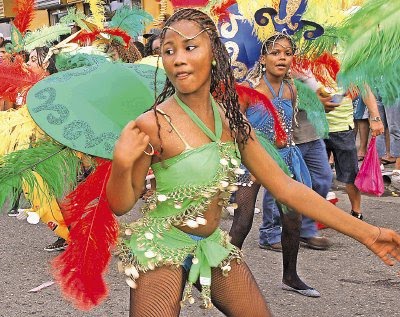
During Carnaval, throngs of people line the streets to watch and cheer on the “beauty queens”, loud marching bands, and to see the brightly colored costumes of the “Comparsas”. Colorfully dressed and adorned coordinated dance troupes, the Comparsas wildly and skillfully shake their booties (booties of ALL ages and ALL sizes!!)to the loud tropical beats of mostly Brazilian Samba & Latin Salsa for miles and miles. It is quite a loud drum banging, hip swinging, cuchi cuchi type show, worth the 2.5 hour drive from San Jose!


My own Adventures at Carnaval:
Having lived on the Caribbean coast for 10 years, I have had the pleasure to personally attend Carnaval. Beyond the great live music throughout the 10 days of the event, one of my favorite parts (and there are many) is the Carnaval Infantil (Children’s Parade). Large macho men run around wearing large “muumuu” style dresses with HUGE handcrafted masks on their heads (see picture).
The “Mascaradas” as they are known, consist of men who play a game known as “Rass’em”. The lucky guy wearing the large mask (check out the peep hole in the picture, so they can see where they are going) chases the other men in the group, and when he is caught, the next guy has to put on the mask and dress and start parading around. A pretty amazing sight for this “macho” society, and really quite entertaining, if not a little creepy!
At night, the Limón Carnaval really comes to life! It’s like an enormous block party with everything located outside in the warm tropical air, just like a county fair, only A LOT crazier!! Rows and rows of booths (or “chinamos” as they are called here) of food, drink, handicrafts, local delicacies (more on those later), and dance floors dot the area and there are always people dancing in the streets (literally)! I personally love the Reggae music coming out of houses, offices and every corner of the city, that is my kind of music “mon”. My biggest challenge is trying to understand the Jamaican Creole dialect. I speak English and am fluent in Spanish, fortunately so are most of the inhabitants of Limon, as otherwise, I would be at a loss for much of what they are saying in their unique dialect. Whoppin? (What’s happening?) Watcha got? (What time is it?) Just a few examples that caused initial confusion on my part, but now seem a natural part of conversation!

The Food of Limon:
Visitors have not had the full Limon experience and definitely not the Carnaval experience without trying some true, authentic Caribbean style food. First and foremost, you must try the “Rice and Beans”. This is not your everyday “gallo pinto”, though it does look the part. This “rice and beans” is made with coconut milk, and if you are really lucky, has a touch of the super hot Panamanian Chilies thrown in for a surprise kick. Some other favorites of the area are the ubiquitous “Pan Bon”, similar
to Christmas Fruitcake in the USA and just as nasty to me, as well as “Pati”, a wannabe tasty empanada and Patacones (double fried Plantains), everything’s better fried!! Am I right? My very favorite has to be…… (drum roll please)…..”cajeta”. A delicious coconut candy with the texture of very firm fudge, this candy can be found sold on almost every street corner, store, bus stop or “chinamo” throughout the City. (I have some stashed in my refrigerator right now.)

In Summary:
If you haven’t had the good fortune to visit the Province of Limon during your Costa Rica vacation, it’s not just about the beaches to the South, or the endangered Marine Turtles to the North! The actual City of Limon is worth a visit, and I can’t think of a better or more exciting time to visit the area then during the yearly celebration of Carnaval!


Author: Kimberly Barron, originally from Malibu, California has lived in Parismina and Manuel Antonio, Costa Rica for 20 years. Starting as a certified tour guide, she spent 15 years managing fishing lodges on the Caribbean Coast and later 4* & 5* Hotels on the Pacific Coast of Costa Rica. Currently semi-retired, Kimberly still works as the Marketing Director for Byblos Resort & Casino and Hotel Makanda by the Sea.

Sources:
http://www.whatsonwhen.com/sisp/index.htm?fx=event&event_id=166975
http://www.yourtravelmap.com/costarica/limon/index.php
http://en.wikipedia.org/wiki/Lim%C3%B3n_Province
http://www.crtraveler.com/articulo.php?id=100
http://www.bukisa.com/articles/28152_limn-carnaval-in-costa-rica-
http://www.insiderslimon.com/CH1Page.html (Photo & Audio credits, please support their cause!)
http://alegresmascaradas.blogspot.com/
http://www.costaricaway.net/artcaribe/pdf/gentecultura.pdf