Showing posts with label holidays in costa rica. Show all posts

Friday, April 11, 2014

Costa Rica’s Juan Santamaria Day! Brave Martyr or Brazen Myth?

Juan Santamaría, an impoverished drummer boy, born of a single mother from the town of Alajuela, is easily the most famous martyr in Costa Rican history, and the only individual to have a National Holiday (April 11) declared in his honor. But was it really Juan Santamaria that saved the day at the Battle of Rivas, or was it more to do with Costa Rica’s need to have a national hero? Read on….

If legend is to be believed, as a result of the Battle of Rivas on April 11th, 1856, Juan Santamaria’s selfless act as his country's impromptu savior brought his eventual rise to glory, fame and martyrdom as he succeeded in saving Costa Rica against the infamous US sponsored invasion of the soldier of fortune style militia of William Walker.

William Walker, a lawyer, doctor and soldier of fortune from Tennessee, hoping to not only exploit the commercial trade route between New York and the Southern tip of Nicaragua, Walker also hoped to conquer the five Central American States with the intention to annex them, extending the new Federation of Southern States, part of the US. Walker and his “filibusteros” (soldiers of fortune) with his new post as a shaky provisional President of Nicaragua planned to instill his political and financial power over the Central American territories, with the next logical step being the invasion of nearby Costa Rica.

Fearing Walker’s growing force in Nicaragua, Costa Rican President Juan Rafael Mora supported by the backing of wealthy American businessmen who wanted their important trading routes reopened, was urged to declare war not on Nicaragua, but on Walker and his filibusters. Furious, Walker ordered the immediate invasion of Costa Rica, crossing the border into the province of Guanacaste, while the Costa Rican army mobilized full speed ahead Northward from the Central Valley. This rag tag army, led by the President’s brother Jose Joaquin Mora and brother-in-law General Jose Cañas, with their contingent of three thousand men marched towards the Walker encampment said to be assembled near the now famous Hacienda Santa Rosa, south of Nicaragua. Upon learning of their imminent arrival, Walkers men made a hasty retreat, taking the battle to Meson de Guerra in Rivas.

That is where Juan Santamaría prominently steps into the picture.

Walker's men, under the command of Colonel Louis Schlessinger, had no sentries posted in the Rivas fort, allowing Mora’s Costa Rican troops to surprise the small American militia, as Schlessinger himself retreated, leaving his troops in complete disarray. When a bloody battle ensued, the commanding Costa Rican officer asked for a volunteer to set fire to thatch roof of the El Mesón de Guerra; the filibusters' stronghold. Surely a suicide mission at best, it is said that Juan Santamaría, an impoverished mulatto drummer boy from the town of Alajuela, stepped up and with torch in hand, approached the hostel and through a hail of bullets, tossed his torch of fire onto the vulnerable thatched roof. This selfless patriotic act caused the enemy to flee, resulting in Juan Santamaria’s death, but leaving him a genuine National Hero.

The deaths of Juan Santamaría and more than a thousand other men saved Costa Ricaand Central America from a complete collapse. The Battle of Rivas put great confidence to the Costa Rican Army in the fight against Walker, who before this battle believed himself undefeatable and unstoppable, and lead to his later assassination in Honduras, during his next attempt at staging a Central American coup.

Although Costa Rica was victorious in the Battle of Rivas, the country did not return back to normal by any means. The numerous dead bodies were not buried in Rivas but were simply thrown into the wells, causing the city a huge outbreak of cholera from the contamination. The troops then carried the disease home with them to Costa Rica where it ravaged the country, killing as much as one tenth of the population. Mora was eventually blamed for the outbreak, as well as other economic problems, and was taken out of power a few years later in 1859.

This is where the dispute of the true legend of Juan Santamaria begins. Heated arguments and several investigations suggest that the well repeated history of Juan Santamaria may not be all it’s cracked up to. According to Steven Palmer, a Canadian researcher, Juan Santamaria was possibly invented by the Liberalist Costa Rican government. Palmer’s study suggests that the government in the late nineteenth
century was seeking to create a national identity in order to unify the disorganized country. Legends, heroes and battles, all helpful ingredients in the creation of a sense of national patriotism, the government set out to find something or someone that would serve its motivating purpose. Since Costa Rica lacks a history of warfare, the Liberalist government chose one of the few significant battles, the 1856 Battle of Rivas fought against William Walker. After choosing the famous battle, a brave hero was to be chosen as their new “symbol” for National unity. With this, Palmer says, Juan Santamaria was “born” or reborn after being dead and forgotten for many decades. That Juan Santamaria was a member of the lower classes, only served to inspire an even stronger sense of belonging to a nation that was coming of its own in world recognition, as Juan Santamaria showed anyone could become a National idol.

Further claims have been discovered that state Juan Santamaria actually died of cholera and not by the bullets of his enemies. Now granted, there are said to be listed four different Juan Santamarias amongst the some 9000 volunteer troops of Costa Rica, so this does open the door for some skepticism and confusion, but it is interesting to consider why Juan Santamaria lay buried for almost four decades, before being remembered and named Costa Rica’s National Hero.

Finally, other historical versions of the Battle of Rivas and the fight at the “Mesón de Guerra”, list the Lieutenant Luis Pacheco Bertora as the first to approach the fort with the idea of flushing out the enemy, but he was gravely injured by gunfire in his attempts. Lying unconscious, a Nicaraguan named Joaquín Rosales made a second attempt to burn the fort, but lost his life in the process. Finally, a third brave soldier stepped forward, the now well-known Costa Rican soldier, Juan Santamaría, who successfully set fire to the “meson” and saved the day for Costa Rica. None of these other brave soldiers have ever received the recognition due them as Juan Santamaria did, much less a National Holiday, statues or International Airports named after them, though the mystery behind the true history of these events lives on!

In the end, there is no attempt to minimize the participation of any of the soldiers involved in this battle, even less so Juan Santamaria. We only hope to give a shout out to all the valiant soldiers who gave their lives to win the liberty and sovereignty of Costa Rica, and to dispel of the rumor that Juan Santamaria was simply approaching the building, tripped and his fire torch accidentally started the fire that ended the battle.

Tell that later version out loud in Costa Rica, and you may be run out of the country even faster than William Walker was!!

Author:
Kimberly Barron, originally from Malibu, California has lived in Parismina and Manuel Antonio, Costa Rica for 20 years. Starting as a certified tour guide, she spent 15 years managing fishing lodges on the Caribbean Coast and later 4* & 5* Hotels on the Pacific Coast of Costa Rica. Currently semi-retired, Kimberly still works as the Marketing Director for Byblos Resort & Casino and owns and manages her own Luxury Vacation Rental Home Business, Manuel Antonio Rental Homes.

Sources:
Lisa Tirmenstein tirmenlb@muohio.edu.
www.Wikipedia.org
http://afehc-historia-centroamericana.org/index.php?action=fi_aff&id=1947
http://www.latindex.ucr.ac.cr/historia-51/10-Aguilar.pdf
http://wvw.nacion.com/ln_ee/2006/abril/28/opinion8.html

Saturday, December 21, 2013

Christmas Season Shopping in Costa Rica? Try the Golfito Duty Free Zone!

Don’t let me be the bearer of bad news, but once again, Christmas is just around the corner. For those of you that have been lucky enough to survive another year of this recession, it’s time to start thinking about Christmas shopping. If you are considering some big ticket items, the duty free zone of Golfito might be just the place for you!

A Little History:
Once a bustling banana port, from 1938 to 1985, Golfito served as the headquarters of United Fruit’s banana operations in the southernmost part of Costa Rica. Creating an economy that had previously not existed, unfortunately the mid-1980s brought declining markets, higher export taxes, worker unrest and banana diseases forcing United Fruit’s departure from the area. Though some of the plantations successfully converted to the production of African Palm Oil, this move was not enough to sustain the job loss and economic blow caused when the company departed. Attracted by the World Class fishing within the Golfo Dulce region, Sport Fishermen have helped stimulate the development of new Costa Rica Hotels & Lodges, creating a flourishing tourist industry in the area. Nonetheless, the Golfo Dulce region and more specifically, the town of Golfito, have continued to struggle for survival, even after close to 20 years of economic stimulus in the form of a Duty Free Shopping Zone.

Government Incentives:
In the 1990’s, in an attempt to boost the region’s economy, the Costa Rica government approved a duty-free facility (déposito libre) in the northern part of the Golfo Dulce zone. Just the mention of the town of Golfito, brings the image of thousands of Ticos on any given day bustling around the rows of this fairly run down mega shopping complex, giving life to an otherwise dying town while shoppers hustle and hustlers shop. Keep in mind….the duty-free shopping is for Costa Rican Nationals and legal residents only, with the most popular purchases being the bigger ticket items. Unfortunately, as you will see below, this is not like a Sunday visit to the local mall, many restrictions apply which can complicate the shopping process, so be sure to read the details.

Rules and Regulations:
The Duty Free Zone was created to help stimulate visits to the region by giving Costa Rican residents a tax free zone to shop for their purchases. To get the most out of these visitors, specific rules were established in order to legally make these tax free purchases. First, exemption from sales taxes is only valid twice a year, with a total purchase amount that cannot exceed $1000 per buyer, per trip. Second, you must stay overnight in Golfito before taking advantage of the tax-free shopping, a requirement enacted to support the area’s family owned “cabinas” and boutique hotels. Third, as a guarantee of your overnight stay, a shopping authorization card (TAC) must be requested at the Customs Offices the day prior to shopping. Hours are Tuesday-Saturday from 8am-8pm, Mondays from 1pm-8pm and shoppers are required to present their valid Costa Rican “cedula” (identification card) when applying.

Hours and Shopping Limits:
When you begin your shopping at Golfito, its recommended to get an early start. Stores open from 8am-4:30pm Tuesday-Saturday and 7am- 2pm on Sundays. Stores are closed on Mondays. When checking out, you will be required to show the store personnel your shopping authorization card, so keep that handy. Remember, one card gives you the right to make a purchase for up to $1,000, though you can combine two cards (no more) for a total of $2,000. The other card can only belong to first-degree relatives such as parents, children, siblings or spouses. Naturally, there are “gavilones” or “tipos” that hang around the area that can arrange that you have sufficient “TAC” cards from “family” to make as many purchases as you need while in the area. Of course, I don’t condone or recommend these services, though they are amazingly efficient and quite convenient:-).

Why go Duty Free?
Though Golfito is no short drive, and the entire process is not exactly convenient, keep in mind that products are not subject to most import taxes, nor the normal 13% Costa Rica sales tax, as well as most products are highly discounted, so thrifty shoppers from around the country can save up to 50% on certain items throughout the year. For those looking for smaller ticket items such as perfumes, cosmetics, liquor, cigarettes, small appliances, tires, computer items, and an assortment of household goods, you might want to save going thru some of these inconvenient restrictions and drive a little further South to the Costa Rica-Panama border. At the border crossing, shoppers can purchase duty-free goods on a mystery strip of shops located between the two borders in the town of Paso Canoas. (You enter one door on the Costa Rica side, and exit the other side of the store on the Panamanian side!) No restrictions apply in this area, and both duty free zones can provide affordable delivery of your purchases throughout the country, but be sure to negotiate the price first!

So if you are planning a shopping jaunt to the port town of Golfito, consider making a short relaxing getaway out of the trip. (You’ll need it after the Golfito zoo.) With the new Costanera Sur highway, the drive is only around three hours from Manuel Antonio/Quepos Area Hotels, and the entire area offers small marinas, yachting and boating services, excellent sport fishing,
as well as easy access to some of Costa Rica’s most beautiful National Parks and protected areas. Although much of the tourism in the Golfito area focuses on the sport fishing industry, other water sports and beach activities are also popular pastimes, with incredible surfing beaches to the south of Golfito such as Playa Pavones; best known as home to one of Zancudo, Pilon and the famous the longest left hand breaking waves in the world. The friendly people of the area, and the fabulous natural wonders that abound make Golfito and the Golfo Dulce more than just a shopping excursion, the area is truly a
beautiful and relaxing place to stop and see more of fabulous Costa Rica! Happy Shopping!

Author:
Kimberly Barron, originally from Malibu, California has lived in Parismina and Manuel Antonio, Costa Rica for 20 years. Starting as a certified tour guide, she spent 15 years managing fishing lodges on the Caribbean Coast and later 4* & 5* Hotels on the Pacific Coast of Costa Rica. Currently semi-retired, Kimberly still works as the Marketing Director for Byblos Resort & Casino and owns and manages her own Vacation Rental Home BusinessManuel Antonio Rental Homes.

Sources:
http://costarica.com
http://www.golfito-costarica.com/golfito/
http://en.wikipedia.org/wiki/Golfito
http://depositodegolfito.com/dlcg/

Tuesday, April 9, 2013

Costa Rica’s Juan Santamaria Day! Brave Martyr or Brazen Myth?

Juan Santamaría, an impoverished drummer boy, born of a single mother from the town of Alajuela, is easily the most famous martyr in Costa Rican history, and the only individual to have a National Holiday (April 11) declared in his honor. But was it really Juan Santamaria that saved the day at the Battle of Rivas, or was it more to do with Costa Rica’s need to have a national hero? Read on….

If legend is to be believed, as a result of the Battle of Rivas on April 11th, 1856, Juan Santamaria’s selfless act as his country's impromptu savior brought his eventual rise to glory, fame and martyrdom as he succeeded in saving Costa Rica against the infamous US sponsored invasion of the soldier of fortune style militia of William Walker.

William Walker, a lawyer, doctor and soldier of fortune from Tennessee, hoping to not only exploit the commercial trade route between New York and the Southern tip of Nicaragua, Walker also hoped to conquer the five Central American States with the intention to annex them, extending the new Federation of Southern States, part of the US. Walker and his “filibusteros” (soldiers of fortune) with his new post as a shaky provisional President of Nicaragua planned to instill his political and financial power over the Central American territories, with the next logical step being the invasion of nearby Costa Rica.

Fearing Walker’s growing force in Nicaragua, Costa Rican President Juan Rafael Mora supported by the backing of wealthy American businessmen who wanted their important trading routes reopened, was urged to declare war not on Nicaragua, but on Walker and his filibusters. Furious, Walker ordered the immediate invasion of Costa Rica, crossing the border into the province of Guanacaste, while the Costa Rican army mobilized full speed ahead Northward from the Central Valley. This rag tag army, led by the President’s brother Jose Joaquin Mora and brother-in-law General Jose Cañas, with their contingent of three thousand men marched towards the Walker encampment said to be assembled near the now famous Hacienda Santa Rosa, south of Nicaragua. Upon learning of their imminent arrival, Walkers men made a hasty retreat, taking the battle to Meson de Guerra in Rivas.

That is where Juan Santamaría prominently steps into the picture.

Walker's men, under the command of Colonel Louis Schlessinger, had no sentries posted in the Rivas fort, allowing Mora’s Costa Rican troops to surprise the small American militia, as Schlessinger himself retreated, leaving his troops in complete disarray. When a bloody battle ensued, the commanding Costa Rican officer asked for a volunteer to set fire to thatch roof of the El Mesón de Guerra; the filibusters' stronghold. Surely a suicide mission at best, it is said that Juan Santamaría, an impoverished mulatto drummer boy from the town of Alajuela, stepped up and with torch in hand, approached the hostel and through a hail of bullets, tossed his torch of fire onto the vulnerable thatched roof. This selfless patriotic act caused the enemy to flee, resulting in Juan Santamaria’s death, but leaving him a genuine National Hero.

The deaths of Juan Santamaría and more than a thousand other men saved Costa Ricaand Central America from a complete collapse. The Battle of Rivas put great confidence to the Costa Rican Army in the fight against Walker, who before this battle believed himself undefeatable and unstoppable, and lead to his later assassination in Honduras, during his next attempt at staging a Central American coup.

Although Costa Rica was victorious in the Battle of Rivas, the country did not return back to normal by any means. The numerous dead bodies were not buried in Rivas but were simply thrown into the wells, causing the city a huge outbreak of cholera from the contamination. The troops then carried the disease home with them to Costa Rica where it ravaged the country, killing as much as one tenth of the population. Mora was eventually blamed for the outbreak, as well as other economic problems, and was taken out of power a few years later in 1859.

This is where the dispute of the true legend of Juan Santamaria begins. Heated arguments and several investigations suggest that the well repeated history of Juan Santamaria may not be all it’s cracked up to. According to Steven Palmer, a Canadian researcher, Juan Santamaria was possibly invented by the Liberalist Costa Rican government. Palmer’s study suggests that the government in the late nineteenth
century was seeking to create a national identity in order to unify the disorganized country. Legends, heroes and battles, all helpful ingredients in the creation of a sense of national patriotism, the government set out to find something or someone that would serve its motivating purpose. Since Costa Rica lacks a history of warfare, the Liberalist government chose one of the few significant battles, the 1856 Battle of Rivas fought against William Walker. After choosing the famous battle, a brave hero was to be chosen as their new “symbol” for National unity. With this, Palmer says, Juan Santamaria was “born” or reborn after being dead and forgotten for many decades. That Juan Santamaria was a member of the lower classes, only served to inspire an even stronger sense of belonging to a nation that was coming of its own in world recognition, as Juan Santamaria showed anyone could become a National idol.

Further claims have been discovered that state Juan Santamaria actually died of cholera and not by the bullets of his enemies. Now granted, there are said to be listed four different Juan Santamarias amongst the some 9000 volunteer troops of Costa Rica, so this does open the door for some skepticism and confusion, but it is interesting to consider why Juan Santamaria lay buried for almost four decades, before being remembered and named Costa Rica’s National Hero.

Finally, other historical versions of the Battle of Rivas and the fight at the “Mesón de Guerra”, list the Lieutenant Luis Pacheco Bertora as the first to approach the fort with the idea of flushing out the enemy, but he was gravely injured by gunfire in his attempts. Lying unconscious, a Nicaraguan named Joaquín Rosales made a second attempt to burn the fort, but lost his life in the process. Finally, a third brave soldier stepped forward, the now well-known Costa Rican soldier, Juan Santamaría, who successfully set fire to the “meson” and saved the day for Costa Rica. None of these other brave soldiers have ever received the recognition due them as Juan Santamaria did, much less a National Holiday, statues or International Airports named after them, though the mystery behind the true history of these events lives on!

In the end, there is no attempt to minimize the participation of any of the soldiers involved in this battle, even less so Juan Santamaria. We only hope to give a shout out to all the valiant soldiers who gave their lives to win the liberty and sovereignty of Costa Rica, and to dispel of the rumor that Juan Santamaria was simply approaching the building, tripped and his fire torch accidentally started the fire that ended the battle.

Tell that later version out loud in Costa Rica, and you may be run out of the country even faster than William Walker was!!

Author:
Kimberly Barron, originally from Malibu, California has lived in Parismina and Manuel Antonio, Costa Rica for 20 years. Starting as a certified tour guide, she spent 15 years managing fishing lodges on the Caribbean Coast and later 4* & 5* Hotels on the Pacific Coast of Costa Rica. Currently semi-retired, Kimberly still works as the Marketing Director for Byblos Resort & Casino and Hotel Makanda by the Sea.

Sources:
Lisa Tirmenstein tirmenlb@muohio.edu.
www.Wikipedia.org
http://afehc-historia-centroamericana.org/index.php?action=fi_aff&id=1947
http://www.latindex.ucr.ac.cr/historia-51/10-Aguilar.pdf
http://wvw.nacion.com/ln_ee/2006/abril/28/opinion8.html

Friday, March 15, 2013

Easter in Costa Rica....Religious Parades, Beach Escapes & the Famous Miel de Chiverre!

Easter Week, or Semana Santa, is easily one of the most important weeks of the year for Costa Ricans. Full of important religious ceremonies celebrating the death and resurrection of Jesus Christ, this predominantly Catholic country finds most locals spending this week with family in prayer, heading out to the beach areas for a short vacation, or more commonly a combination of both. Traffic can be horrendous, in part because on Good Friday public bus routes shut down completely to allow employees time to celebrate the holiday with their own families. Public transportation options become limited and can be extremely crowded and inconvenient during this holiday.

In most areas of Costa Rica, the local Catholic Church organizes traditional masses, as well as daily religious processions or celebratory parades generally starting on Holy Wednesday, and continuing through Holy Thursday, Good Friday and Easter Sunday. Sometimes these ceremonies start as early as Monday, continuing through the entire week. Usually consisting of dramatic reenactments of Jesus’ journey through Jerusalem to his crucifixion and resurrection, with fake blood in place, some of the graphic depictions are not always pleasurable for the faint of heart.

Actors, dressed as Roman soldiers, take part with a host of other easily recognized characters in the journey towards Jesus’ eventual death. Most commonly spotted in these processions or local parades are Angels, Mary Magdalene, Saint Joseph, the Virgin Mary, Apostles and naturally, Jesus, the most coveted dramatic role of all. Participants proclaim to have lived the last year free of sin, while following closely the church’s teachings, though this point could be argued in many a town. Nonetheless, considered a very serious event, large numbers of spectators line the streets to mourn, pray and celebrate.

Traditionally during Holy Week, practicing Catholics prepare special dishes centering around the main ingredient, Seafood. Keeping in line with the observance of not eating meat on Fridays during Lent, delicious typical Costa Rican dishes are shared, such as rice and shrimp, fish ceviche, fried whole fish, canned tuna, as well as a variety of local desserts such as empanadas, rice pudding, rosquillas (donuts), polvorones (cookies), eggnog, Chicha (a hot drink made from aguadulce, ginger and cinnamon), and a popular jelly made from “chiverre”, a large squash similar to a watermelon. (See recipe below.)

Catholics are given all of Lent to attend Confession, while church hours are expanded to accommodate higher numbers arriving to confess before Easter, since the sacrament is not available Thursday through Sunday. The extended hours also allow further preparation for the processions including decorating and cleaning the religious effigies, many of which will take part in up to 10 processions, requiring different colored clothing for each one.

Tourists visiting Costa Rica, or “Ticos” not attending religious ceremonies with family, all head for the beach, converting sleepy beach towns into overcrowded party zones, while hotels in both small towns and tourist hubs throughout the country are in normal years completely booked months in advance. Travelers on roads leading to and from the coastal towns can sit in traffic for hours. San Jose and other Metropolitan Areas become literally deserted ghost towns as all government institutions, schools and banks close from Thursday to Sunday, or as is the case this year, many are closing from Sunday to Sunday.

In recent years, the common practice of enforcing the “Dry Law” during Holy Week has become a bit more relaxed, with enforcement by police officials sporatic and unorganized, especially in high tourist zones. The Dry Law specifies that as of midnight on Wednesday, all bars, restaurants and liquor stores close, and no alchohol can be served or sold until Saturday. According to Catholic tradition, followers are to refrain from drinking alchoholic beverages during the mourning of Jesus Christ, until his resurrection on Easter Sunday. Even though the majority of the Costa Rican population is Catholic, many citizens stock up on liquor and beer to take them through the festive week, while other entrepreneurial spirits make a side business of selling beer and liquor out the back door or even the trunk of their car during those dates.

Though many a devoted churchgoer may still choose to indulge in a drink or two, superstitions abound, and Ticos are known to keep an eye over their shoulder during this time. Many won’t swim in the ocean on Holy Thursday or Friday, fearing they will drown because God is angry. Others believe you can turn into a fish if you get in the water on Holy Friday. Another common superstition is the thought that the earth gets hotter, causing more earthquakes during this time. Surprisingly, this has been fairly true this year, but is more likely just a coincidence. An older superstition states that it is a sin to drive a car during Holy Week, and some small towns are said to still throw nails on the street to deter anyone who would consider the sin of driving during these dates. I thankfully have personally never seen this done in my 20 years of living in Costa Rica.

In one particular town, Ortega de Santa Cruz in Guanacaste, men continue to participate in an age old tradition that involves capturing a large crocodile with their bare hands on Good Friday and tying it up to put on display in the center of town. Even though the animal is released the following day, the tradition has been under scrutiny of animal and environmental conservationists for years and each year is said to be the last. Unfortunately, it has also grown in popularity as many curiosity seekers head to the small town to witness the exhibition in person.

On the positive side, it is widely agreed upon that some of the best weather and certainly some of the best sunsets of the year happen during Holy Week, another excellent reason to be at the beach. So should you find yourself in Costa Rica during this holiday week, feel free to come join in the festivities and be sure to try the Chiverre Jelly listed below!!


Miel de Chiverre
Ingredients:
Large chiverre
Dulce de caña in (2) tapas or 1 kilo of granular brown sugar
cinnamon
cloves
250 grams brown tamarindo seeds (Optional)
250 grams of coconut pieces or flakes (Optional)
(Tapas of dulce de caña are the little circular blocks of brown sugar available at every Costa Rican market.)
Preparation:
Over a fire or using a kitchen burner, char as much as possible of the shell of the chiverre.
When done, hit the shell firmly with a hammer to expose the contents which looks like spaghetti squash or fine hairs.
Put the insides in a clean pillowcase and use the clothes drier to reduce the moisture.
When the chiverre contents are drier, cook it in a big sturdy pot over low heat. Cover the entire flesh of the chiverre with whichever sugar you are using, white, brown or the tapa. Sprinkle with the tamarindo seeds, cinnamon, cloves, lemon or orange peel and if desired, the coconut. The chiverre will naturally produce enough liquid to complete this process.
Cover the pot and let it cook slowly over low heat for 90 minutes, stirring often to avoid sticking.
Allow to cool and either transfer to a jar or use for other dishes.
The jelly is widely used in dessert empanadas, cookies and other dishes where a touch of sweetness is desired.

Author:
Kimberly Barron, originally from Malibu, California has lived in Parismina and Manuel Antonio, Costa Rica for 20 years. Starting as a certified tour guide, she spent 15 years managing fishing lodges on the Caribbean Coast and later 4* & 5* Hotels on the Pacific Coast of Costa Rica. Currently semi-retired, Kimberly still works as the Marketing Director for Byblos Resort & Casino and Hotel Makanda by the Sea.

Wednesday, December 28, 2011

Don't be "Fooled" while in Costa Rica!

Are you a fool every day, just on April fool’s Day, or surprise!.... you could be proven a fool while in Costa Rica in late December! December 28th in Costa Rica is “Dia de Los Inocentes” (Day of the Innocents), commonly considered “Fool’s Day”, which to us North Americans is customarily celebrated on April 1st, also commonly known as April Fool’s Day in the United States.

Did you fall for any pranks or jokes on December 28th? Did you get caught off guard?? Costa Rican’s love to pull off large and small pranks on their friends and family on this yearly day of tom-foolery. Everything from the simplest of jokes, to the common gesture of putting a sign on your back that might reads “kick me” or “looking for love”, to more vulgar jokes such as wrapping dog poop in toilet paper, lighting it on fire and waiting for the nearest “Innocent” to stomp out the fire, or another favorite in our humid climate, leaving a melting chocolate candy on someone’s seat so when they sit down, it later looks like they pooped in their pants when they rise. All pretty funny, as long as you are not the innocent fool!!

The history of “Dia de Los Inocentes” dates back some 2000 years. The origin of the “Day of the Innocent Saints” is very different in modern times from it’s previous inception as the day in which there was a slaughter of all male children of 2 years or younger. Ordered by King Herodes, he was voted King of the Jews by the Roman Senate, and was considered the Roman Client King of Israel. Not to be confused with his son, Herod Antipas, also of the Herodian dynasty, the elder Herod is known for his colossal building projects in Jerusalem and other parts of the ancient world, including the rebuilding of the Second Temple in Jerusalem, sometimes referred to as Herod's Temple. He was described as "a madman who murdered his own family and a great many rabbis.” Herod is reported in the Gospel of Matthew as personally ordering the Massacre of the Innocents. Most recent biographers do not actually regard this as an actual historical event, though the legend lives on and scripture has been found that could support the legend.

According to Matthew, shortly after the birth of Jesus, Magi (the three wise men) from the East visiting Herod to inquire as to the whereabouts of "the one having been born king of the Jews", as they had seen his star in the East and therefore wanted to pay him homage. Herod, who himself was considered King of the Jews, was alarmed at the prospect of a newborn king possibly usurping his rule one day. In the story, Herod assembled the chief priests and scribes of the people and asked them where the "Anointed One" was to be born. Their answer, Bethlehem. Herod then sent the Magi to Bethlehem, instructing them to search for the child and after finding him, to "report to me, so that I too may go and worship him". However, after they had found Jesus, the Magi were warned in a dream not to report back to Herod. Upon realizing that they would not communicate the exact location of the birth of Jesus, an infuriated Herodes ordered the massacre of all boys two years and under in Bethlehem and its outlying areas.

In regards to the Massacre of the Innocents, although in reality Herod was certainly guilty of many brutal acts, including the killing of his wife and two of his sons, no other known source from that period makes any references to such a massacre. Since Bethlehem was a small village, the number of male children under the age of 2, would probably not have exceeded 20 or so. This could be one of the reasons for the lack of other sources for this questionable account of history, although Herod's order in Matthew 2-16 includes those children in Bethlehem's vicinity meaning the massacre area could have measured a significantly larger amount numerically and geographically more in the area of some 14,000 children. The infants, known in the Church as the Holy Innocents, have been claimed as the first Christian martyrs.

How this turned into an annual celebration of trickery remains a mystery. It is said that during the Middle Ages, pagan rites were introduced in to the celebration that for some time came to be known as the “Celebration of the Crazy People” (“Dia de Los Locos”). It was celebrated between Christmas and New Year, a direct show of the significance of Jewish and Christian sentiments during the holy season. Out of this shift in sentiment, over time a new tradition began that combined the underlying pagan sentiment with and the light hearted Christian monks teachings, with the main purpose of the day being the moment to pull all types of pranks on unsuspecting family and friends. Pranks are known as “inocentadas” and their victims are called “inocentes”, or alternatively, the pranksters are the "inocentes" and the victims should not be angry at them, since they could not have committed any sin. It is still not understood how such a morbid historical event could be converted over the centuries to celebrate a completely opposite sentiment and will likely remain a mystery to all.

So if you find yourself in most any Latin American country on December 28th, don’t be surprised if you are the butt of someone’s joke. Be warned, the Costa Rican culture has a wonderful sense of humor, meaning no one is safe on this day FOOL!!

Author:: Kimberly Barron, originally from Malibu, California has lived in Parismina and Manuel Antonio, Costa Rica for 20 years. Starting as a certified tour guide, she spent 15 years managing fishing lodges on the Caribbean Coast and later 4* & 5* Hotels on the Pacific Coast of Costa Rica. Currently semi-retired, Kimberly still works as the Marketing Director for Byblos Resort & Casino and Hotel Makanda by the Sea.

Saturday, December 10, 2011

A Costa Rican Christmas in that Special "Tico" Style!

In case you haven´t noticed, Costa Rica Christmas decorations and discount sales began long before Halloween dates passed. This brings to mind some of our own special ¨Tico¨ Christmas traditions found in our beautiful tropical locale. Be it the kids that start their ¨summer¨ vacations in December, workers that receive their yearly ¨aguinaldo¨ (an automatic one month salary Christmas Bonus from their boss), or the massive preparations of the traditional Christmas Tamales……whichever it may be, ¨La Navidad¨ is just around the corner!

Will there be snow? Well that is highly unlikely since Costa Rica is located only 11° off the Equator, but Costa Ricans are fascinated by snow, since few have everseen the real thing. Many of the floats in the yearly ¨Festival de la Luz¨ scheduled for this evening at 6pm down Paseo Colon and Second Ave in San Jose, are decorated in fluffy white cotton fabrics to give the impression of snow, and many holiday participants threw white confetti at each other, also meant to simulate snow. This year, the municipality once again is put a firm hand down on the throwing of this confetti due to safety factors, as well as the high cost of clean-up afterwards. In years past, there have been many complaints from innocent bypassers walking to work who were suddenly blanketed from head to toe in the white confetti.

Costa Rica´s animal lovers wait anxiously each year for ¨El Tope Nacional¨ usually held the day after Christmas on December 26th. This parade includes marching bands, clowns and other strange characters, but is most popular for featuring some 6000 of Costa Rica´s most beautiful high stepping horses, as well as the famous colorful hand painted oxcarts. These fabulous detailed oxcarts were originally pulled by people, then by oxen, and now are rarely used in day to day work, but are considered historical works of art cherished by the Costa Rican people.

The traditional Christmas tree, more often decorated in hues of blue, gold, silver,
white and maybe a little red, is accompanied by another important decoration, the ¨Portal¨. The Portal is the representation of the birth of Jesus, with the figures of Mary, Joseph, the three wise men, the ox and the mule. The most important figure in Costa Rica is the Baby Jesus. In Costa Rica, Santa Claus doesn't bring the Christmas gifts, those are brought by Baby Jesus on Christmas Eve. Called ¨La Nochebuena", it is said that while the family is sleeping, the Baby Jesus appears at the portal and the gifts magically appear under the tree for the morning of the 25th. That is when all family members typically gather around the tree and pray, thanking Baby Jesus for all the good that has passed that year, followed by the opening of the gifts Baby Jesus has bestowed upon them.

The Christmas menu is extensive, but the focus is around the preparing and eating of typical Costa Rican "tamales". The true "tamal" base is of ground corn, which is
made into a thick dough that is later filled with small amounts of rice, small slices of potatoes, vegetables, green olives, pork or chicken, and finally wrapped in fresh plantain leaves. They are then tied with string in pairs (known as ¨Piñas¨) and boiled until cooked through and through. Making "tamales" is a cherished tradition that involves the participation of many family members and friends, as this is a slow and laborious process taught by Grandmothers from one generation to another. I am lucky enough to have many Tico friends that take pity on my lack of knowledge (or motivation!) to make the tamales and each year give me the gift of the famous Tamal!

Easily, the most chaotic and perhaps crazy activity of the holiday season is the "Zapote Bullfights", held in the town of Zapote, just outside of downtown San
Jose. It is there that they build a special ¨Redondel¨ or Bull Ring, as well as erect a yearly improvised amusement park complete with carnival rides, amusement park games and a selection of "chinamos", or improvised food stands. It´s important to note that in the Costa Rican bullfights, the bulls are never harmed, or killed, though the “bullfighters” do not always fare so well (see videos below). The most prestigious cattle ranches provide the bulls for free and it is considered an honor to have their bulls included in this event. Beyond the actual riding of the large bulls (generally done in Costa Rica with NO hands), much more frightening are the bullfighters in the ring. These consist of ¨normal¨ people dressed in all kinds of crazy outfits, that willingly get into the arena in mass without any professional preparation to ¨fight¨ or spook the bulls, encouraging them to chase them around the arena. Incredibly, very few people get hurt or gored during this event, though the activity is definitely entertaining and a big headache for the local Red Cross which voluntarily provides it's emergency services during this yearly event. It´s interesting to note that this festival year after year draws Costa Ricans from all parts of the country and crosses all social classes.


The Holiday Season then officially ends on January 6th, the day the three wise men arrived and saw Baby Jesus for the first time. That day all the neighbors gather and say a special prayer for the Baby Jesus. This prayer is based on the rosary and traditional Christmas carols. Of course after the prayer, there's the indulging in
the famous Costa Rica coffee, along with more "Tamales", "Rompope" (Costa Rican Egg Nog), "Aguadulce" (a Sweet Water like juice) and all kinds of typical baked goods and other traditional beverages. Don´t forget the grapes (no seedless ones here) and the apples, which are considered very special treats here, as they are not readily available or very affordable and kids love them!

Lastly, Costa Rican Hotels and tourism operations around the country eagerly await the arrival of December to usher in their peak tourist season when winter weary snowbirds look to bask in the warm tropical weather and waters of Costa Rica, as well as enjoy the bounty of adventure tours and the beauty of Costa Rica´s incredible natural resources. I hope if you are reading this you are lucky enough to share in our bounty this Holiday Season!

MERRY CHISTMAS OR FELIZ NAVIDAD Y PROSPERO ANO NUEVO!


Author: Kimberly Barron, originally from Malibu, California has lived in Parismina and Manuel Antonio, Costa Rica for 20 years. Starting as a certified tour guide, she spent another 15 years managing fishing lodges on the Caribbean Coast and later 4* & 5* Hotels on the Pacific Coast of Costa Rica. Currently semi-retired, Kimberly still works as the Marketing Director for Byblos Resort & Casino and Hotel Makanda by the Sea.

Thursday, September 29, 2011

Carnavales in Limon Costa Rica....an Annual Tradition!!


When: October 10-16, 2011 (annual event)
Where: Limón
Cost: Free
Hours: All hours!!

If you are presently on vacation in Costa Rica, or planning to make your getaway soon, Costa Rica's port town of Limón on the Caribbean side of the country, converts to an all out party every October to celebrate “Carnaval”! Vaguely disguised around celebrating Columbus Day (October 12th) or “Dia de Las Culturas” (as we know it in Costa Rica), locals as well as every strange character you can think of join together in the overconsumption of alcohol, while dancing and parading the streets of Limon to the popular Latin beats of blaring Calypso, Reggae, Samba, Salsa and many other tropical rhythms! A good time is generally guaranteed, all in the name of history, culture and a legitimately good reason to Party!

Background of Limon:
Limon (Spanish for Lemon) is the largest “city” on the Caribbean side of Costa Rica, as well as the center for Costa Rica’s largest commercial shipping port in nearby Moin. Serving as the capital city of the Limon Province, Christopher Columbus set anchor in 1502. It is said that Limon was named after the large lemon tree that used to grow where the City Hall is now located, but that rumor has not substantiated over the years.
Also known at the Pearl of the Caribbean, Limon is an exotic province characterized by the friendly openness of its culturally diverse population, as well as the richness of its Afro-Caribbean customs.
Limon’s economy is based primarily on banana, cacao and pineapple production and exportation, as well as the raising of cattle, though the yearly cruise ship season brings a large influx of tourism to the area. Considered to have the largest population of black people in all of Costa Rica, the Afro-Caribbean culture derives from mostly Jamaican descent. Originally brought to this area as slaves to build the railway connecting the Atlantic coastline with the Central Plateau (San Jose) for the shipping of goods by land, a large Chinese immigrant population also remains from this same ambitious project.

Highlights of “Carnaval”:
The first Carnaval (that is the correct spelling for Costa Rica), was held in 1949 and was the brainchild of the late Alfred Henry King and friends, who felt it was a good opportunity to unite the Costa Rican culture (originally descendents from Spain) together with the primarily black Caribbean Culture (mostly African, Caribbean and Chinese descendents), which had suffered strained relationships throughout Costa Rican history. In just over 60 years, the Carnavales de Limon is now considered the most popular Festival in the entire country. It’s interesting that Costa Rica does not celebrate Columbus arriving to “America”; it celebrates the uniting of cultures. Pretty forward thinking!
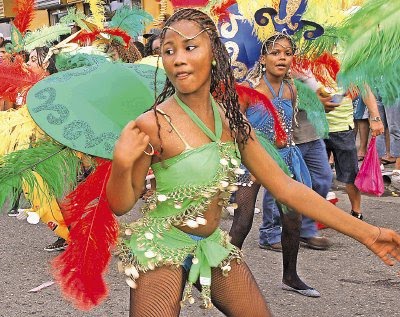
During Carnaval, throngs of people line the streets to watch and cheer on the “beauty queens”, loud marching bands, and to see the brightly colored costumes of the “Comparsas”. Colorfully dressed and adorned coordinated dance troupes, the Comparsas wildly and skillfully shake their booties (booties of ALL ages and ALL sizes!!) to the loud tropical beats of mostly Brazilian Samba & Latin Salsa for miles and miles. It is quite a loud drum banging, hip swinging, cuchi cuchi type show, worth the 2.5 hour drive from San Jose!


My own Adventures at Carnaval:
Having lived on the Caribbean coast for 10 years, I have had the pleasure to personally attend Carnaval. Beyond the great live music throughout the 10 days of the event, one of my favorite parts (and there are many) is the Carnaval Infantil (Children’s Parade). Large macho men run around wearing large “muumuu” style dresses with HUGE handcrafted masks on their heads (see picture).
The “Mascaradas” as they are known, consist of men who play a game known as “Rass’em”. The lucky guy wearing the large mask (check out the peep hole in the picture, so they can see where they are going) chases the other men in the group, and when he is caught, the next guy has to put on the mask and dress and start parading around. A pretty amazing sight for this “macho” society, and really quite entertaining, if not a little creepy!
At night, the Limón Carnaval really comes to life! It’s like an enormous block party with everything located outside in the warm tropical air, just like a county fair, only A LOT crazier!! Rows and rows of booths (or “chinamos” as they are called here) of food, drink, handicrafts, local delicacies (more on those later), and dance floors dot the area and there are always people dancing in the streets (literally)! I personally love the Reggae music coming out of houses, offices and every corner of the city, that is my kind of music “mon”. My biggest challenge is trying to understand the Jamaican Creole dialect. I speak English and am fluent in Spanish, fortunately so are most of the inhabitants of Limon, as otherwise, I would be at a loss for much of what they are saying in their unique dialect. Whoppin? (What’s happening?) Watcha got? (What time is it?) Just a few examples that caused initial confusion on my part, but now seem a natural part of conversation!

The Food of Limon:
Visitors have not had the full Limon experience and definitely not the Carnaval experience without trying some true, authentic Caribbean style food. First and foremost, you must try the “Rice and Beans”. This is not your everyday “gallo pinto”, though it does look the part. This “rice and beans” is made with coconut milk, and if you are really lucky, has a touch of the super hot Panamanian Chilies thrown in for a surprise kick. Some other favorites of the area are the ubiquitous “Pan Bon”, similar to Christmas Fruitcake in the USA and just as nasty to me, as well as “Pati”, a wannabe tasty empanada and Patacones (double fried Plantains), everything’s better fried!! Am I right? My very favorite has to be…… (drum roll please)…..”cajeta”. A delicious coconut candy with the texture of very firm fudge, this candy can be found sold on almost every street corner, store, bus stop or “chinamo” throughout the City. (I have some stashed in my refrigerator right now.)

In Summary:
If you haven’t had the good fortune to visit the Province of Limon during your Costa Rica vacation, it’s not just about the beaches to the South, or the endangered Marine Turtles to the North! The actual City of Limon is worth a visit, and I can’t think of a better or more exciting time to visit the area then during the yearly celebration of Carnaval!

Author: Kimberly Barron, originally from Malibu, California has lived in Parismina and Manuel Antonio, Costa Rica for 20 years. Starting as a certified tour guide, she spent 15 years managing fishing lodges on the Caribbean Coast and later 4* & 5* Hotels on the Pacific Coast of Costa Rica. Currently semi-retired, Kimberly still works as the Marketing Director for Byblos Resort & Casino and Hotel Makanda by the Sea.

Sources:
http://www.whatsonwhen.com/sisp/index.htm?fx=event&event_id=166975
http://www.yourtravelmap.com/costarica/limon/index.php
http://en.wikipedia.org/wiki/Lim%C3%B3n_Province
http://www.crtraveler.com/articulo.php?id=100
http://www.bukisa.com/articles/28152_limn-carnaval-in-costa-rica-
http://www.insiderslimon.com/CH1Page.html (Photo & Audio credits, please support their cause!)
http://alegresmascaradas.blogspot.com/
http://www.costaricaway.net/artcaribe/pdf/gentecultura.pdf

Saturday, September 10, 2011

Get out the Red,White & Blue….it’s Costa Rica Independence Day!

It’s September again and in Costa Rica that means “Mes de La Patria” (Patriotic Month)! This colorful time finds the entire country in a month long celebration of their Independence from Spain with patriotic displays of their red, white and blue flag, colorful parades, thematic dances, concerts, the march of “Faroles” (more on that later) and any other number of celebrations throughout the country. Most events culminate around “Dia de Independencia” (Independence Day), which takes place on September 15th and this year will be the 190th year!!

A country rich with national pride, Costa Rica encourages its citizens from a very young age to appreciate their Independence Day traditions which are to be celebrated and passed on to future generations. Schools plan elaborate patriotic displays and lively celebrations both the night of September 14th, as well as more parties, parades and civic marches on September 15th, an official National Holiday. For the school children, this month marks the culmination of many months of patriotic preparation, social studies on the importance of the date, as well as providing a special night to show off their artistic talents with the march of the “Feroles” (elaborate homemade paper lanterns).

Although September 15th is the official date to recognize Costa Rica’s independence from Spain in 1821, unlike independence battles common to many other countries, this actually wasn't a particularly significant event for Costa Rica at the time, as the country had basically functioned independently for years from the Capitanía General of Guatemala. However, after the final Spanish defeat in the Mexican War of Independence (1810 to 1821), the authorities in Guatemala declared Independence for all of Central America. So, even though the official date of independence is in 1821, Costa Rica had basically been on it’s own for some time due to Spain's lack of economical, political and even religious interest in this very poor region.

Nonetheless, the “Ticos” take a great sense of pride in their freedom and their official festivities actually begin on September 14th when a series of runners carry the “freedom” torch from Nicaragua (stopping for Costa Rica in the city of Cartago) and continue all the way to Panama. This is meant to be a re-enactment commemorating history when an official “news” runner ran from border to border of the then Federal Republic of Central America, notifying the people of the region of their official liberation. Costa Rica did not actually get the news until October 13th, 1821!

The runners, selected from local schools throughout Central America to carry the torch an average of 500 meters each, take on their task with great honor, as the mission serves as a great source of patriotic pride throughout the region. These runners cross the Nicaraguan border into Costa Rica each year on the eve of the day of independence arriving to the (then) capital city of Cartago, where the torch is usually welcomed by the acting president of the country, presently…. Laura Chinchilla. At this same time, most of the country grinds to a halt as almost all TV and radio stations broadcast the national anthem, with most citizens singing along whether they be young or old, home or standing on a street corner, whether riding a bus or driving a car, wherever they may find themselves, their enthusiastic patriotism is both humbling and contagious.

This impressive event is soon followed in even the smallest of pueblos and including the large cities by the sound of the local fire truck sirens that announce the beginning of the “Parade of Faroles”. These often elaborate homemade paper lanterns (with candle or light source inside) are meant to symbolize the original torch run and are proudly carried throughout the streets overhead on short poles by children, with their parents generally following closely along for safety purposes. The faroles are family projects and their design and size can vary greatly from child to child. Some resemble small “Tico” houses, others look like glittering globes, and others are elaborate “typical” scenes of churches or well known national symbols found in Costa Rica. The march of the faroles is often followed by a parade of children dancing traditional dances in adorable typical costumes….a sight that should not be missed!

Another daytime community parade takes place on the morning of September 15th which now includes the adults, important town functionaries, patriotic community members, and just about anyone who chooses to march along and show their pride for Costa Rica. Folks that live along the parade route generally have their houses and yards decked out with large Costa Rican flags and banners to celebrate the big day and they enthusiastically wave their flags as the parade marchers pass by.

So if you are lucky enough to live in or be visiting Costa Rica in the month of September, you are sure to take notice of the many festive displays of Tico pride and patriotism just about everywhere you go throughout the country. Therefore, don’t forget to join in and wear your own red, white and blue in celebration of Costa Rica’s “Mes de Patria”, the Ticos will welcome you with open arms and their usual big smiles will get even larger as the whole country celebrates Independence and Democracy!!

Sing along to the Costa Rica National Anthem!

Author:
Kimberly Barron, originally from Malibu, California has lived in Parismina and Manuel Antonio, Costa Rica for 20 years. Starting as a certified tour guide, she spent 15 years managing fishing lodges on the Caribbean Coast and later 4* & 5* Hotels on the Pacific Coast of Costa Rica. Currently semi-retired, Kimberly still works as the Marketing Director for Byblos Resort & Casino and Hotel Makanda by the Sea.